
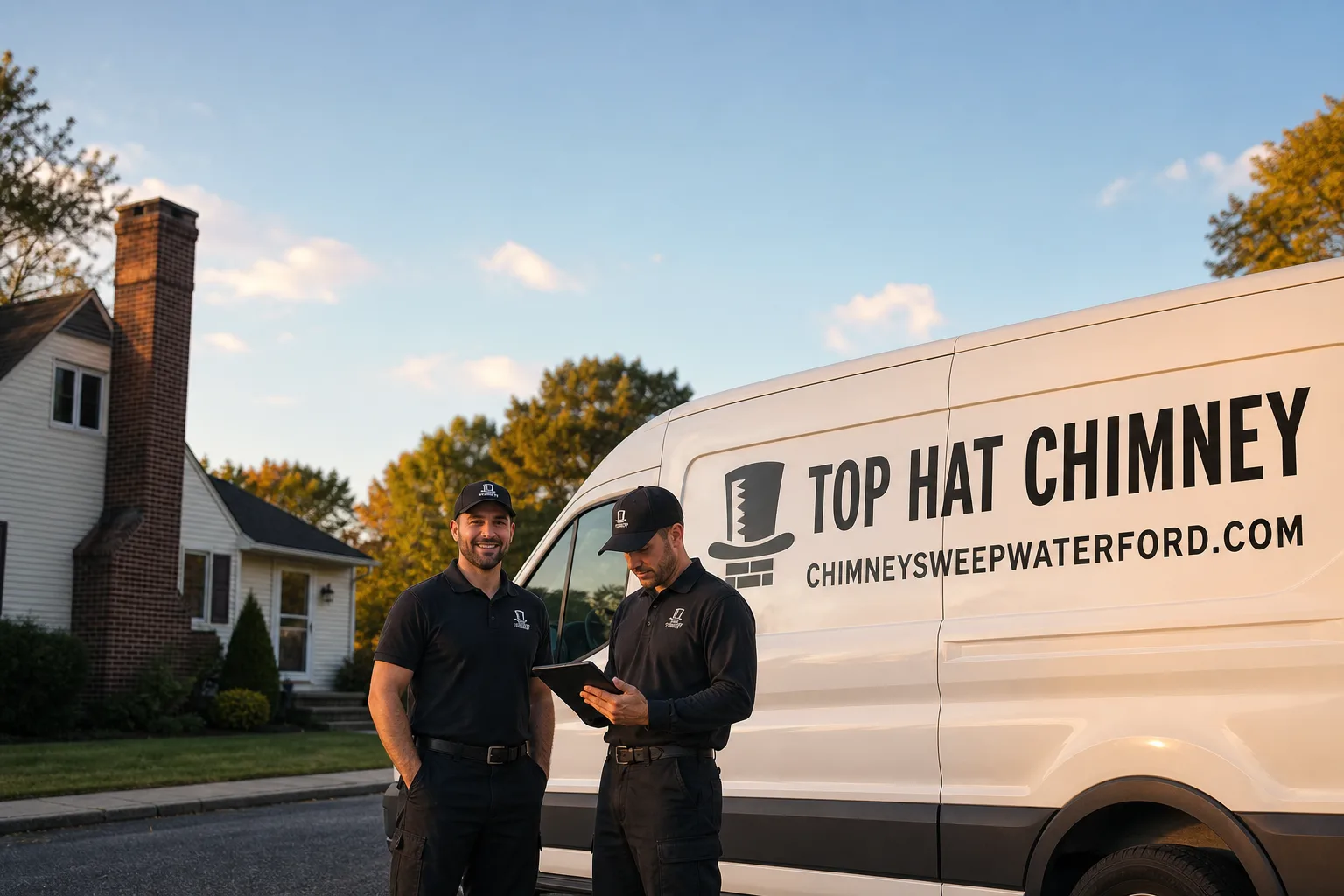
Level 1 sweep and inspection to the NFPA 211 annual standard - flue, crown, cap, and flashing checked and photographed
Chimney sweep logs do not sweep chimneys. They loosen some creosote - which then falls where a brush and vacuum still have to collect it.


 Before
 After
After Before
 After
After Before
 After
AfterFast, Reliable Chimney Cleaning & Sweep Across Mullica
If you’re burning wood in Mullica, your chimney is working harder than almost any other in Atlantic County. The pitch pine that grows everywhere in the Pinelands puts down creosote faster than the oak and cherry burned in most of New Jersey, sometimes twice as fast. That’s why we tell every homeowner off Weekstown Road, along Nesco Road, and out toward the Mullica River the same thing: sweep annually, minimum, and inspect after every serious storm. Top Hat Chimney has been cleaning and repairing chimneys since 1999, and Wendell Pike still answers the phone. Call (856) 699-1992 for a straight answer and an honest price.
Key Takeaways
- Pinelands pitch pine builds creosote faster than hardwood, so annual sweeping in Mullica is a baseline, not a suggestion.
- Storm damage here is usually a displaced cap, a cracked crown, or failing flashing. All three let water into places it shouldn’t be.
- Our camera inspections show you exactly what we see, and we’ll tell you plainly if a repair can wait.
- Upfront pricing, no trip charge inside the county, and a 90-Day Done Right Promise in writing on every job.
Why Top Hat Chimney Is Mullica’s Preferred Chimney Cleaning & Sweep Company
We’ve worked Mullica long enough to know the houses off Elwood Road, the older farmsteads set back from Moss Mill Road, and the cabins that sit damp and shaded along the cedar swamps. That matters when you’re deciding whether a chimney needs a sweep or a repair, because the answer is rarely the same house to house. A center-hall colonial in Williamstown and a hunting cabin near the river have different chimneys, different liners, different fires. Wendell and his crew have been inside enough of both to know the difference by sight. Ask anyone on your street who’s had a chimney fire scare or a ceiling stain after a Nor’easter. We’re the ones who showed up, gave a real arrival window, and put the price in writing before a single tool came off the truck.
You won’t get a call center when you reach us. A live person answers around the clock, and it may well be Wendell himself picking up at 2 a.m. when you’re worried about smoke backing into the house. Every technician who arrives is background-checked and in uniform. And here’s the part that matters most to homeowners who’ve been burned before by national outfits: we hand you camera footage of your flue and a plain-English verdict on what’s worth doing now and what can wait. No upsell. No “while we’re here” surprises. If the work isn’t right, the 90-Day Done Right Promise brings us back at no additional cost. One call, and it’s handled.
Our Chimney Cleaning & Sweep Services in Mullica
Every job in Mullica starts the same way: a hard look at how your chimney has been living since the last time it was touched. Pitch pine creosote, storm damage, and Pinelands humidity each leave their own marks. Here’s what we do, and how it applies to what you’re burning and where you live.
Level 1 Inspection
A Level 1 inspection is what you get with every annual sweep. We’re checking the readily accessible parts of the flue, the damper, the firebox, and the cap. In Mullica, we pay close attention to the cap and crown, because wind-driven rain off the bay and relentless humidity will find any gap and make it bigger. If your chimney is standard and you burn seasoned wood, this is the inspection you need yearly. Most Mullica chimneys that have been burning pitch pine for even one cord will show first-degree creosote at this stage. Catching it here means a brush job, not a rotary tool job.

Level 2 Inspection
You need a Level 2 inspection when something has changed: you’ve bought the house, you’re changing fuels, you’ve had a chimney fire, or a storm has done visible damage. This is a video inspection with a camera run the full length of the flue. After a Nor’easter, we routinely find cracked tiles, separated liner sections, and water penetration that a visual check from the roof would miss. In Mullica’s older farmhouses, Level 2 inspections uncover something structural in a meaningful percentage of cases, often because the original unlined masonry or a grandfathered Type 1 woodstove install has been quietly absorbing moisture for decades. The camera footage and a plain-English verdict, every time, no exceptions.

Creosote Removal
If you’re burning unseasoned or partially seasoned pitch pine from the Pinelands scrub, you’re making creosote faster than you realize. One cord of wet pitch pine can leave first-degree deposits. By midwinter, that often hardens into second-degree glaze, and we’ve seen third-degree tar-like glaze in the smoke chamber of what looked like an ordinary single-family chimney. Standard brushing won’t touch third-degree. That’s when we bring out rotary power cleaning tools with plastic or metal heads to restore the flue opening. Your flue doesn’t care how the fire looks. It cares how it breathes. First-degree creosote is a brush job. Third-degree is a glaze. Catch it early, and a sweep is a couple hundred dollars. Let it go, and it’s a liner.

Soot Removal
Soot is softer and brushable, mostly from wood that burns hot and clean. But in Mullica, soot and creosote tend to arrive together, because nobody burns only seasoned hardwood down here. Soot removal is part of our standard sweep, and we clean the smoke chamber, damper, and firebox while we’re at it. If you heat with a woodstove, we pull the connector pipe and clean it thoroughly, because that’s where a dry, powdery soot load can build up fast and block your draft. Heavier glazing means we move to rotary tools. Every sweep concludes with a visual check and a report on what we found, in plain language.

What happens when you call
- 1
A real person answersNo phone trees - you reach a local pro.
- 2
You get an upfront price rangeHonest numbers before anyone is dispatched.
- 3
A background-checked tech heads outLicensed & insured, dispatched right away.
- 4
You approve before work beginsNothing starts until you say go.
Trusted Brands We Service in Mullica
When a Mullica chimney needs parts rather than just labor, we work with brands we’ve trusted for years, which means we’re not quoting you whatever the big-box store had on sale. We install Olympia Chimney caps and crowns that hold up to Atlantic County weather. We use DuraFlex for liner replacement when the old clay tiles are cracked or spalling. And we service HeatShield and Famco components, so when we find a problem during a sweep, we can often fix it the same visit rather than scheduling a follow-up. That matters in winter, when a chimney that’s down for a week is a cold house and a cold family. Our Chimney Cleaning & Sweep team stocks what Mullica homes need, so you’re not waiting on a part from across the country.
Common Chimney Cleaning & Sweep Problems We See in Mullica Homes
Mullica has a way of testing chimneys that the rest of Atlantic County doesn’t. Here’s what we find over and over, and why it shows up at your door:
- Displaced or missing chimney caps after severe weather. Wind-driven rain from coastal Nor’easters enters through the open flue and soaks the liner. The water then moves into the firebox and down the smoke shelf, staining the hearth and accelerating spalling.
- Cracked crowns that let water behind the flashing. Mullica’s freeze-thaw cycles act on a saturated crown, and once a crack opens, water works its way down to the flashing and into the attic. By the time you see a ceiling stain, water has been moving for weeks.
- Third-degree glazed creosote from unseasoned pitch pine. Wet, resinous Pinelands wood doesn’t burn clean. It smolders at lower temperatures, producing thick, tar-like deposits that standard brushes can’t remove. This is the single most common reason we need rotary power tools in Mullica.
- Spalling liner tiles in older farmhouses and cabins. Persistent humidity and decades of water intrusion flake the interior of clay tile liners. Those flakes fall into the smoke shelf and firebox, and the liner walls thin out until they’re a fire hazard rather than a protective barrier.
Pricing for Chimney Cleaning & Sweep in Mullica, NJ
A standard chimney sweep in Mullica, assuming a single flue and no major surprises, typically runs $189 to $289. Creosote removal with rotary tools, which we recommend when glaze has formed from burning pitch pine, runs $259 to $389 depending on how bad the glazing is and how long we’re on the roof. A Level 2 inspection with video camera runs $149 to $249 on its own, and we often bundle it with a sweep when you’ve had a storm or a chimney fire. If you have an older farmhouse with a second flue, add $59 to $99 for the extra flue. We give you the exact price before we start, always. And there’s no trip charge when you’re inside the county. Call (856) 699-1992 and Wendell will walk you through what you’re likely to spend before anyone gets in a truck. Seniors and veterans always get 10% off, and any repair over $200 takes $40 off automatically.
We Also Serve Cities Near Mullica
If you’re in Mullica, we’re already working roads you know from the inside of a chimney truck. We serve Waterford and Winslow, Monroe and Williamstown, and the smaller unincorporated stops between them. Same crew, same pricing, same promise. If you’re just down the road and wondering whether we cover your chimney, call (856) 699-1992 and ask. The answer is almost always yes.
Storm Damage and Mullica Chimneys: What Actually Happens
In Mullica, nearly every chimney is in regular contact with pitch pine from the surrounding Pinelands. That’s not a detail we mention for color, it’s the single biggest factor in how fast creosote builds up here. Our sweeps expect to find first-degree creosote within one cord of burning, and often second-degree glaze by midwinter. You won’t see that in nearby Hammonton, where oak is more common, because resinous conifers burn differently. They produce more particulate, more tar, more of everything that sticks to flue walls. This Mullica page exists to tell you what a Pinelands storm does to your chimney, from displaced caps to flashing leaks, and why your creosote buildup is worse than anywhere else in Atlantic County.
But the storms compound it. Mullica sits where coastal wind and wetland humidity collide. When a Nor’easter comes through, wind-driven rain flows sideways, not down. It finds the gap under a loose cap and runs down the flue. It pools on a cracked crown and seeps into the masonry. It works behind flashing that’s been softened by decades of Pinelands moisture. And here’s the part no one warns you about: a chimney doesn’t fail all at once. It fails quietly, over one storm, one freeze-thaw cycle, one wet season at a time. You won’t know until a ceiling stain shows up or smoke starts bleeding back into the living room.
We worked on an older farmhouse off Weekstown Road after a Nor’easter lifted the chimney cap and water ran down the flue into the firebox. We found the storm had also cracked the crown, and the flashing was already failing from years of Pinelands humidity. After a full sweep with rotary power tools to remove tar-like third-degree creosote from the smoke chamber, we installed a new Olympia Chimney cap and sealed the crown, before the first fire of the season.
That farmhouse wasn’t unusual. It’s the pattern we see across Mullica: a storm finds the weak point, water gets in, and then the real damage starts. Check your cap, check your crown, check your flashing after every serious storm. If you don’t want to get up on the roof, that’s exactly why you call us. The check is quick, the camera doesn’t lie, and the fix is usually far cheaper before winter than after it.
Serving Mullica, NJ - Our Local Coverage Area
We’re based in the Mullica area and know this community well. Use the map below to see our service coverage - if you’re nearby, we can almost certainly help.
FAQs - Chimney Cleaning & Sweep in Mullica
Roughly twice as fast. Pitch pine is resinous, and when it burns, it releases tar-like particulates that condense on flue walls as creosote. One cord of unseasoned pitch pine can leave first-degree deposits where a full cord of seasoned oak would leave almost none. By midwinter, Mullica chimneys that started the season clean often show second-degree glaze. The fix is an annual sweep, without exception, and honest wood management. If you’re burning scrub pine, don’t expect a brush to handle what a rotary tool will need to remove by February. Call (856) 699-1992 and we’ll tell you exactly what your flue is holding onto.
Check the cap first. If it’s shifted, missing, or dented, water has likely entered the flue, and you should not burn until it’s inspected. Next, look at the crown for fresh cracks or spalling. Third, scan the ceiling below the chimney for a stain or a damp spot, which means flashing has failed and water is moving through the roof. If any of these are present, call us for a Level 2 inspection with a camera before you light anything. A storm-damaged chimney that gets a hot fire can crack tiles further and turn a $300 cap replacement into a $6,000 liner job. Call (856) 699-1992 for a free estimate.
Spalling happens when water inside masonry freezes and expands, flaking off the surface of brick and tile. Mullica’s Pinelands humidity means chimneys are almost never fully dry. When Atlantic County’s freeze-thaw cycles hit a saturated chimney, the expansion pressure flakes clay tiles and faces of brick. It’s a slower process than a visible crack, but it’s constant. Chimneys near the cedar swamps or the river take the worst of it. The preventative step is keeping water out: a sealed crown, intact flashing, a cap that stays put. Call (856) 699-1992 to have yours checked before the next freeze arrives.
You’ll get away with it in the sense that your house won’t catch fire that night. But one load of wet pitch pine deposits a layer of creosote that becomes the base for the next load, and the next, and the next. It builds like paint, each layer curing onto the last, until a hot fire suddenly ignites the whole lining. That’s how chimney fires happen in houses that “always burn that wood.” The better answer: burn only seasoned wood, and if you suspect a season’s worth of wet pine has gone up the flue, schedule a sweep before it costs you a liner. Call (856) 699-1992 for an honest look at what’s in there now.
Yes, and not because older workmanship was bad. It’s because older Mullica farmhouses and cabins were built before chimney liner codes existed. Many still have original unlined masonry or Type 1 woodstove installs that were grandfathered in. Those systems were never designed for decades of freeze-thaw cycling in Pinelands humidity. A newer home with a stainless liner and a properly flashed cap will shrug off a storm. An older one will absorb it, slowly, until the liner cracks or the flashing lets go. If your home predates modern code, a Level 2 camera inspection is the smartest $200 you’ll spend on it. Call (856) 699-1992 to book one, and we’ll show you the footage ourselves.
Contact Top Hat Chimney in Mullica
Chimney work in Mullica isn’t a commodity. It’s your heat, your roof, and your family’s safety in one brick column, and it deserves a sweep who knows this town and its chimneys by name. Wendell Pike founded Top Hat Chimney in 1999, and he still stands behind every job with the 90-Day Done Right Promise, in writing. If you’re off Route 30, out near the river, or back in the pines past Weekstown Road, give us a call at (856) 699-1992. A live person answers, and the estimate is free. We’ll tell you what’s wrong, what’s urgent, and what can wait. No pressure. Just the truth, with camera footage to back it up.
Written by Wendell Pike, Owner at Top Hat Chimney, serving Mullica and surrounding communities since 1999.